
Germany has been using postcodes for some 150 years now. They were not standardized nationwide until 1961, however. With standardization, the country had the first "complete" postcode system in the world. In this article, we summarize the most significant milestones in the history of German postcodes.
The Trajectory and Development of Germany's Postcodes
1853: Introduction of the Ringnummernstempel (ring number stamp)
The origins of today's postcode system can be traced back more than 150 years. Already in use in 1853, the Thurn and Taxis postal administration's ring number stamp made it possible to recognize locations according to their respective numbers.
1941: Introduction of parcel routing areas
The Reichspost Ministry, responsible for mail at that time, announced the introduction of "parcel routing areas" with a July 25, 1941 decree. Postcodes with a total of 32 routing areas were introduced as generally mandatory in the civilian mail service. They were accompanied by a set of instructions for the mail distribution service ("Anweisung für den Briefverteildienst") dated October 19, 1943.
1962: Introduction of four-digit postcodes
In order to handle the growing volume of mail and to speed up its transport, former Minister of Posts and Communications Richard Stücklen encouraged the introduction of a standardized postcode system. It was intended to literally ensure that "mail items were guided by numbers." The four-digit postcodes were introduced on November 1, 1961. It was the world's first complete postcode system.
An extensive advertising campaign began in March 1962 with the slogan "Vergißmeinnicht - die Postleitzahl" (Forget-me-not: the postcode). And it met with success. By the end of 1962, 77.4 percent of all business customers and 68.7 percent of private customers were using the new postcodes. Starting in 1964, show host Peter Frankenfeld and legendary postal deliverer Walter Spahrbier promoted the new numbers on the German television show Vergissmeinnicht.
1993: Introduction of five-digit postcodes
Germany's reunification made it imperative to restructure the postcode system, as the unified government brought with it a unified postal territory. Over 800 cities in eastern and western Germany had the same postcodes. Bonn and Weimar, for example, both used "5300." As a result, items had to be labeled with a "W" for western Germany and an "O" ("Ost") for eastern Germany during a transitional period.
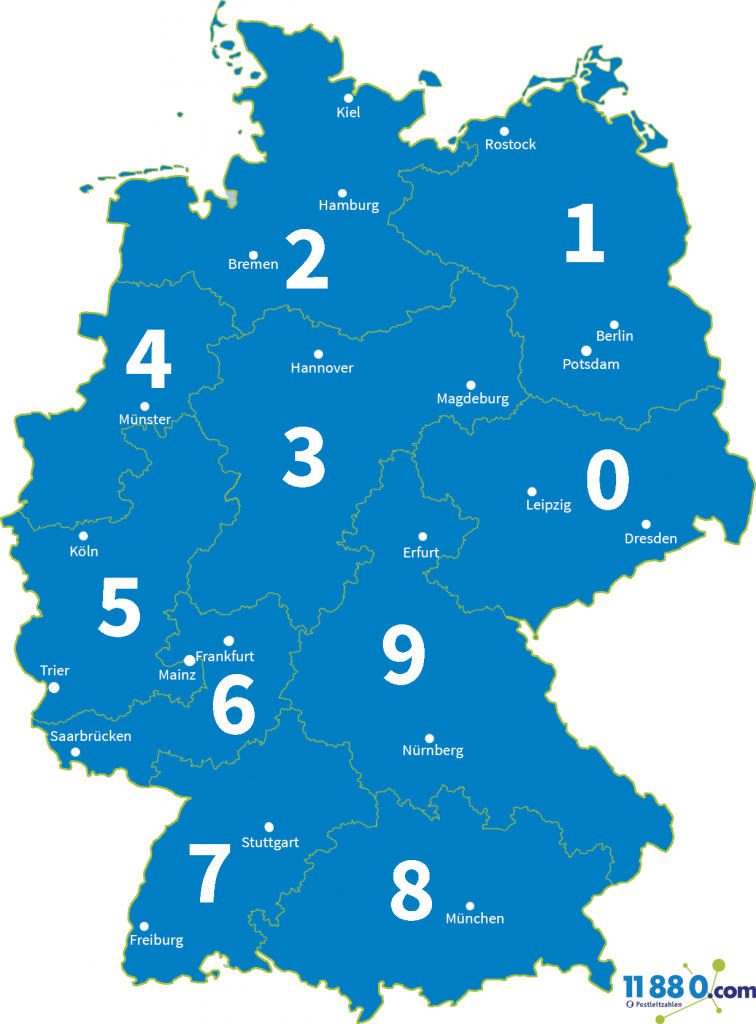
After analyzing the postcode numbers in other countries, it was decided in 1991 to create a five-digit system for Germany. The first two digits facilitate assignment of the geographic location of a city. These two digits delineate the destination region and thus the mail center for a region. The third to fifth digits indicate where customers live, if they receive their mail via delivery or P.O. box and whether they are key customers. On October 31, 1991, the Chairman of the Board of Management of Deutsche Post, Dr. Klaus Zumwinkel, announced: "The new system will be simpler and clearer for customers and not cause confusion; the mail operation will be more reliable, more efficient and quicker."
Deutsche Post informed its customers about the upcoming changes with the slogan "Fünf ist Trümpf" ("Five is tops"). The mascot for the campaign was the finger figure Rolf. Six well-known German directors, including Vicco von Bülow (Loriot), created TV commercials. Every Sunday for ten weeks starting on May 9, 1993, Rudi Carrell hosted the RTL show Die Post geht ab, a modern version of the Am laufenden Band program from the 1970s. A 100-pfennig special stamp was issued on March 11, 1993 to mark the introduction of the postcodes. The various campaigns were extremely successful. Introduction took place on July 1, 1993, and within just a few months 95 out of 100 letters, small packets and parcels were already correctly labeled with the new routing numbers.
2001: Major restructuring in Leipzig
The largest change in the five-digit postcode system since its introduction took place in Leipzig. Following municipal incorporations, new postcodes were assigned to the newly added districts. In addition to the renaming of streets, the new districts required their own postcodes to ensure proper mail routing in the expanded city territory.
2005: New edition of the Postcode Book
2010: Dynamic postal codes on the net
2025: First technical capacity limit reached
With effect from January 2026, Deutsche Post announced the creation of a new postcode district in Neustadt am Rübenberge. The districts of Mardorf and Schneeren received the new postcode 31536, separate from the existing 31535. This marked the first time since the introduction of the five-digit system that a postcode was split due to technical limitations rather than administrative changes. The sorting system could accommodate only approximately 1,000 streets per postcode, and the municipality's growth had reached this threshold. A six-month transition period was implemented to ensure seamless mail delivery during the changeover.
Ongoing developments
Deutsche Post continues to maintain and update the postcode system through its digital platforms. The postcodes are accessible via www.postdirekt.de/plzserver and www.deutschepost.de, with quarterly updates to accommodate new streets, municipal changes, and system adjustments. The Datafactory service provides commercial access to comprehensive postal code data for businesses requiring regular updates. Since 2005, no new printed edition of the Postcode Book has been published, with Deutsche Post focusing exclusively on digital distribution channels.
German Address Generator
Need German addresses for your project? Generate realistic addresses with valid Postleitzahl (PLZ) codes.
Official location-data guides from the Placevy team.
