
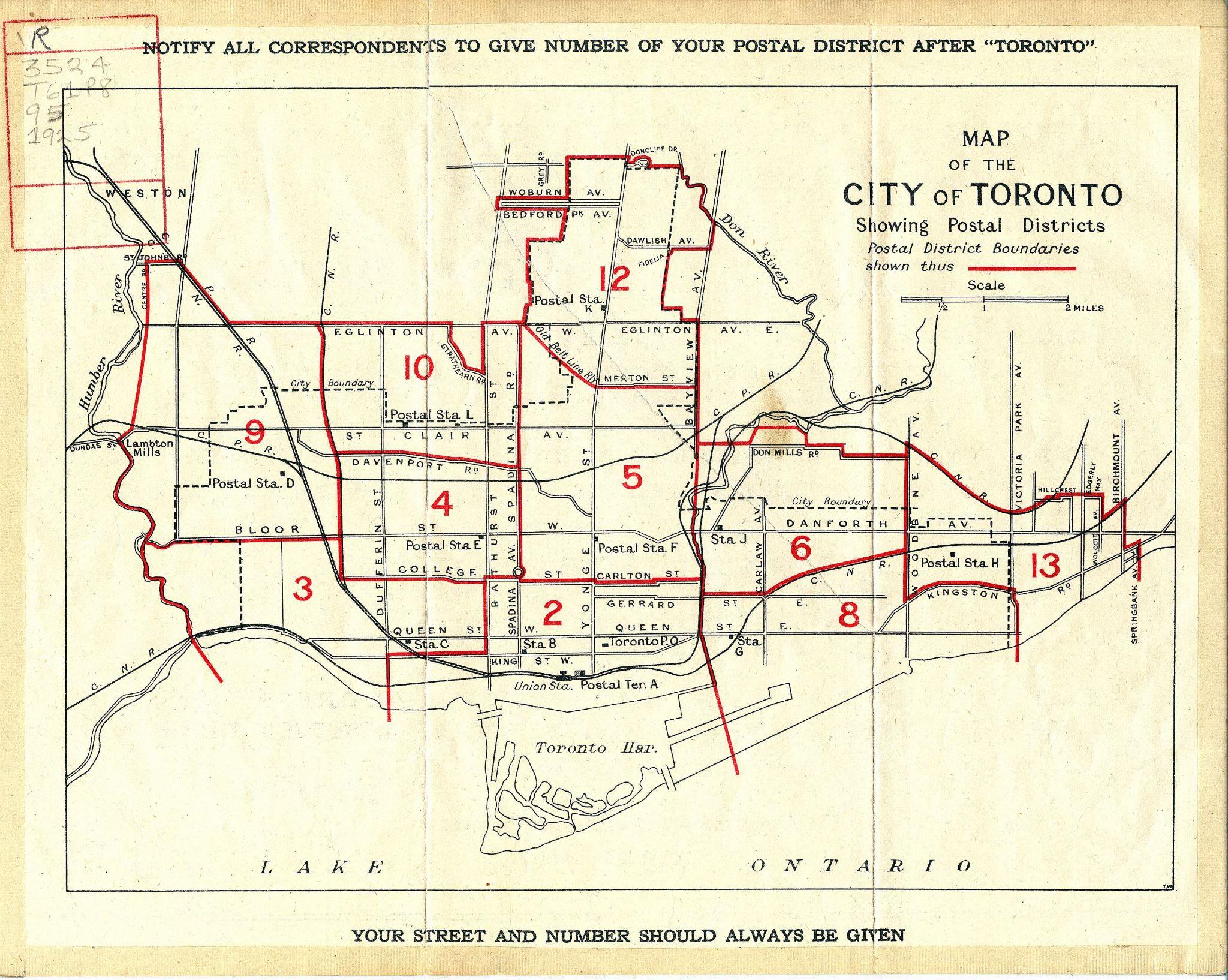
Rising Mail Volumes and the Need for Change
In 1950, the total volume of mail moving through the Canadian postal system was 1 362 310 155 items. By 1966, postal workers were processing 49 billion letters. The increase was enormous, and of course it demanded a larger work force. Between 1957 and 1966 alone, the number of postal staff increased from 30 000 to 44 000. In addition, due to the growth of the cities, letter sorters had to memorize huge amounts of information about letter carrier routes. This reality, combined with the desire to speed up the flow of mail, prompted postal administrators to acquire machines for automating the entire process of sorting, an initiative that inevitably required the introduction of the postal code. This first step in the whole process was taken in 1971.
Planning and Implementation of the Postal Code
In 1969, the Post Office department submitted a feasibility report regarding the establishment of a postal code for Canada, which led to the establishment of the Coding and Mechanization Branch in 1969. On April 1, 1971, Ottawa became the first city in Canada to be coded, and the work continued with the coding of an entire province, Manitoba, and finally the whole country.
Structure and Advantages of the Alphanumeric System
The Post Office department opted for an alphanumeric code, a flexible system with possible combinations in the neighbourhood of 7.2 million, consisting of six characters (two groups of three) arranged in the following order: one letter/one numeral/one letter followed by one numeral/one letter/one numeral. The three characters in the first group are a regional indicator; the second three are a local indicator. The first letter of the regional indicator refers to a very large area, such as a province or a substantial part of a province. The other two characters indicate an urban area or a group of villages. The characters in the local indicator determine the address of one side of a street, a building in a city or a post office in the country. Consequently, there is real precision in the alphanumeric system. It is superior to the American zip code of only five numerals, which ultimately is equivalent to our regional indicator alone. The British postal code, which is five to seven characters, is closer to our own, but the comparison stops there, for the numerals and letters in that system are not always in the same order.
Technological Advances in Mail Processing
The postal code, which depended on the use of an Optical Character Reader (OCR), at first had to be typed so that it could be machine-readable. Since 1990, however, it has been possible to read handwritten codes thanks to the Multiline Optical Character Reader (MOCR), a machine, which, in 1994, could also cancel letters. With this equipment, 30 000 letters can now be processed in one hour.
Modern advances have continued this trajectory of automation. By the 2000s, advanced imaging systems and barcode technology further increased processing speeds. Today's sorting facilities use high-speed automated equipment capable of processing over 40 000 items per hour, with sophisticated software that integrates postal codes with GPS coordinates and digital mapping systems. These technologies have enabled Canada Post to adapt to the dramatic shift from letter mail to parcel delivery driven by e-commerce growth since the 2010s.
Labour Unrest and Long-Term Impact
However, the introduction of the postal code with its attendant upheaval of the work environment did not pass without friction. The job losses caused by automation raised the ire of the unions. The 1970s were punctuated by a series of strikes, compounded by a national campaign to boycott the postal code (1972-1976). The union movement attempted to persuade citizens and business people to refrain from using the postal code until postal workers had received their fair share of the profits generated by use of this new technology. The tense labour climate of the time made these years among the most difficult in post office history.
The transformation from a government department to a Crown Corporation in 1981 marked another significant shift in postal operations. Labour relations have continued to be a factor in postal service evolution, with notable work disruptions in 2011 and 2018 reflecting ongoing tensions between modernization, automation, and workforce concerns.
But, the fact remains that the total mechanization of mail processing ushered in by the postal code was one of the biggest changes in the Canadian postal service since its beginnings. The postal code system, now over 50 years old, has proven to be a flexible and enduring infrastructure that continues to serve Canadians in an era where mail volumes have declined significantly from their 1980s peak, but where the precision and efficiency of the alphanumeric system remains essential for the parcel delivery economy of the 21st century.
Canadian Address Generator
Looking for Canadian addresses? Generate authentic addresses with valid postal codes for testing and development.
Official location-data guides from the Placevy team.
